
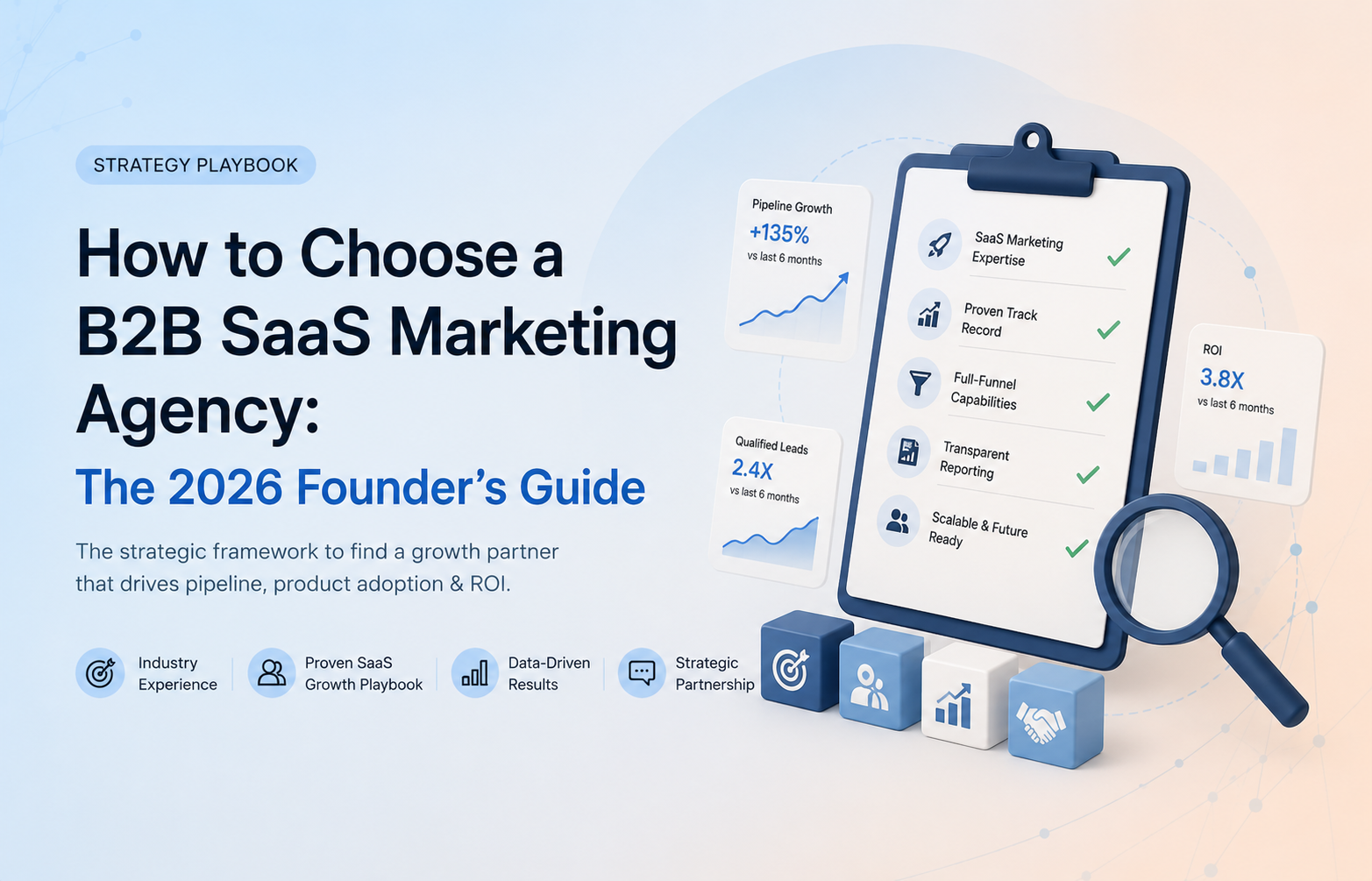
B2B SaaS Marketing Agency: The 2026 Founder’s Guide
You have spoken to four agencies this month. They all said the same things. Full-funnel strategy. Data-driven approach. Proven frameworks. Dedicated account manager.
None of them told you what happens in month two when the leads are not coming in. None of them explained how they think about your sales cycle, your churn rate, or the difference between a marketing-qualified lead and one that your sales team will actually care about.
They were all selling. None of them were advising.
That is the core problem with hiring a SaaS marketing agency in 2026. The market is crowded, the pitches are polished, and the gap between what agencies promise and what they deliver has never been wider. Founders are burning six months and significant budget finding this out the hard way.
This guide will not help you find the most impressive agency. It will help you find the right one.
Why SaaS Marketing Is a Specialist’s Game
Before you evaluate any agency, you need to understand why most generalist agencies will fail you. It is not because they lack talent. It is because SaaS is a fundamentally different business model to everything else they work on.
A retail brand measures success in transactions. An e-commerce business measures ROAS. A SaaS company lives and dies by monthly recurring revenue, net revenue retention, and the relationship between customer acquisition cost and lifetime value. These are not marketing metrics. They are business metrics that marketing directly drives.
When you hire an agency that does not understand MRR expansion, they will optimise for signups instead of activated users. They will celebrate traffic spikes while your trial-to-paid conversion sits at 9 percent. They will build you a content strategy without understanding your ICP’s buying committee, which in B2B SaaS often involves three to seven decision-makers before a deal closes.
The right B2B SaaS marketing agency does not just run campaigns for you. They think like a growth partner. That means they understand your funnel from first touch to renewal, and they can identify where the actual leak is before they start plugging holes.
7 Things to Look For Before You Sign
1. SaaS-Specific Portfolio, Not Just Digital Marketing Experience
This is the first filter. Ask to see case studies from SaaS clients, specifically B2B SaaS if that is your model. Ask what the product was, what the ACV was, and what the agency actually drove in terms of pipeline, not just traffic or social impressions.
Agencies that have worked with SaaS companies understand long sales cycles. They know that a blog post targeting a bottom-of-funnel keyword can generate a demo request six months after someone first reads it. They have built nurture sequences for buyers who take 90 days to evaluate a tool. That experience is not transferable from a D2C client portfolio.
You can see how Voxturr approaches SaaS-specific growth across our client case studies, covering everything from IoT SaaS platforms to contract management tools.
2. Demand Generation Thinking, Not Just Lead Generation Tactics
There is a critical difference between an agency that generates leads and one that builds demand. Lead generation is transactional: capture an email, run a drip sequence, push to sales. Demand generation is strategic: shape the market’s thinking so that when buyers are ready, your product is already their shortlist.
The best SaaS marketing agencies in 2026 operate at both levels. They build top-of-funnel content that creates category awareness. They run mid-funnel campaigns that capture in-market buyers. And they have a clear framework for how those two connect, so you are not choosing between brand and performance. You are building a system that compounds.
Ask any agency you evaluate: how do you think about demand generation versus lead generation? If they treat these as the same thing, they are not ready for a serious SaaS growth mandate. For a deeper breakdown of what effective SaaS lead generation looks like in practice, this is worth reading before your next agency call.
3. Honest Reporting That Goes Beyond Vanity Metrics
Agencies that are not confident in their results hide behind metrics that look impressive but mean nothing. Impressions. Reach. Engagement rate. These are inputs, not outcomes.
A serious SaaS marketing agency will report on metrics that connect to revenue: MQLs generated, SQL conversion rate, pipeline influenced, cost per qualified opportunity, and ideally, closed revenue attributed to marketing activity. They will also tell you when something is not working and why, instead of burying it in a 40-slide monthly report.
Before you sign, ask: what does your standard reporting look like? Ask them to walk you through a recent client report. If they cannot draw a straight line from their activity to your business metrics, that is a problem you will discover too late.
4. A Clear Opinion on Your Go-To-Market Strategy
Agencies that win your business by agreeing with everything you say are not partners. They are vendors. The right agency will push back. They will tell you if your ICP definition is too broad. They will flag if your pricing page is killing your trial conversion. They will challenge your assumption that paid search is the right channel at your current stage.
This is not arrogance. It is what you are actually paying for. You can hire execution capacity anywhere. Strategic clarity about what will move the needle for your specific business, at your specific stage, in your specific market. That is the rare thing.
In your first conversation with any agency, present them with a real growth challenge. Watch how they respond. Do they ask sharp questions or jump to solutions? Do they challenge your framing or validate it? That response will tell you more than any case study they show you. The growth hacking approach Voxturr uses is built on exactly this: diagnosing before prescribing, every time.
5. Channel Expertise That Matches Your Buying Cycle
B2B SaaS has a specific set of channels that tend to compound over time: organic search, LinkedIn, content marketing, email, and product-led growth loops. Some agencies are excellent at paid acquisition but weak on organic. Others are strong on content but cannot run a sophisticated ABM programme.
The right fit depends on where you are. If you are at seed stage with a $2M ARR target, you need channel diversity and experimentation. If you are at Series B pushing toward $20M ARR, you need depth in two or three channels that are already showing signal.
Be specific about what you need. Do not hire a full-service agency for everything if you have a clear channel hypothesis. And do not hire a specialist if you have not yet found what works. If paid acquisition is a priority for your stage, understanding how PPC works for SaaS businesses will help you ask sharper questions during evaluation.
6. A Pricing Model That Aligns Incentives
How an agency charges you tells you a lot about how they think. A pure retainer model means they get paid whether results arrive or not. A purely performance-based model creates short-term thinking. The agency will chase quick wins at the expense of compounding strategies.
The best models in 2026 are hybrid: a base retainer that covers strategic work and execution, with performance bonuses tied to agreed metrics. This aligns the agency’s incentives with your outcomes without forcing them into short-term tunnel vision.
Ask any agency to explain their pricing model and what it is designed to do. If you want a clear view of what SaaS marketing agency pricing actually looks like across different service tiers, including what drives costs up and what you can reasonably negotiate. This breakdown covers it in full.
7. A Team You Can Reach When Something Goes Wrong
Every agency looks good in the pitch. The test is month three, when a campaign is underperforming and you need someone who understands the full context of your business to diagnose the problem quickly.
Ask about account structure. Who is your day-to-day contact? Are they a senior strategist or a junior account executive? What is their team’s experience level? How quickly do they typically respond when something needs attention?
Agency relationships that fail do not usually fail because of strategy. They fail because of communication breakdowns, unclear ownership, and misaligned expectations about what responsive looks like. Clarify this before you sign.
Red Flags That Most Founders Miss
They promise specific results before they understand your business. Any agency that tells you they will get you 200 leads per month in the first conversation has not asked enough questions. Results depend on your product, your market, your price point, your sales process, and your current brand awareness. An agency promising outcomes before diagnosing the situation is selling, not advising.
Their case studies are all traffic and ranking stories. Organic traffic is a means to an end. If an agency cannot show you what happened to pipeline and revenue as a result of their SEO work, their definition of success is not your definition of success.
They do not ask about your sales process. Marketing and sales in B2B SaaS are not separate functions. If an agency does not ask how your sales team qualifies leads, how long your average deal takes to close, or what happens after someone books a demo. They are building a marketing machine that is disconnected from the revenue engine it is supposed to feed.
They are not curious about your churn. Acquisition strategy in SaaS is inseparable from retention. If your churn is high, pouring money into acquisition is expensive and futile. The right agency asks about churn early, because it tells them whether the marketing problem is at the top of the funnel or the bottom. This is also why understanding the full SaaS marketing funnel matters before you hire anyone to manage it.
They cannot tell you what they will not do. Agencies with no clear positioning do everything for everyone. That sounds flexible, but it usually means they have not built deep expertise in anything. The best agencies have a clear point of view on where they are strong and where they will refer you to someone else.
10 Questions to Ask Any SaaS Marketing Agency Before You Sign
These are not polite questions. They are diagnostic ones. The quality of the answers will tell you more than the pitch deck.
- Can you walk me through a SaaS client engagement where results took longer than expected? What happened and what did you do?
- How do you define a qualified lead for a B2B SaaS business, and how does that definition get aligned with a client’s sales team?
- What is your view on the right channel mix for a company at my stage and ARR?
- How do you approach attribution when our sales cycle is 60 to 90 days?
- What does your reporting look like at month one versus month six?
- Have you worked with a product like ours before? If not, what is your process for getting up to speed on a new category?
- Who specifically will be working on my account day to day, and what is their background?
- What would cause you to recommend we change our strategy significantly mid-engagement?
- What does an exit from your agency look like? What assets and institutional knowledge do we retain?
- If I called one of your current SaaS clients right now, what would they say is the one thing you do better than anyone else?
What a SaaS Marketing Agency Should Actually Deliver
Before you evaluate scope, it is worth getting clear on what a full-service SaaS marketing engagement looks like. Many founders sign with an agency expecting one thing and receive another.
A serious B2B marketing agency should be capable of covering the full acquisition and growth surface.
Organic search and content marketing builds compounding traffic from buyers researching your category. This is the channel that pays dividends 12 months from now if you start today. Knowing how SaaS marketing is fundamentally different from other business models is what separates agencies that get this from ones that will give you a generic content calendar.
Paid acquisition on Google and LinkedIn captures in-market demand immediately. For B2B SaaS, LinkedIn in particular allows targeting by job title, company size, and industry. That means you can reach CFOs at Series B fintech companies if that is your ICP. Google Ads for SaaS requires a very specific setup to work profitably. Most agencies get this wrong.
Account-based marketing for enterprise deals targets specific high-value accounts with precision. If your ACV is above $15,000, ABM is not optional. It is the only way to engage buying committees efficiently. Voxturr’s 7-step B2B SaaS ABM framework covers exactly how this works in practice.
Email marketing and marketing automation nurtures long sales cycles without burning your sales team’s time. The difference between a lead that converts in 30 days and one that converts in 180 days is often a well-designed nurture sequence. Voxturr’s marketing automation services are built specifically for SaaS companies with this problem.
SaaS SEO requires specific expertise in ranking product-led content, comparison pages, and integration pages. These are the pages buyers visit when they are three days away from making a purchase decision. Understanding technical SEO for SaaS is what separates agencies that understand this from ones that will give you a generic keyword strategy.
Lead generation infrastructure includes landing pages, forms, lead scoring, and CRM integration. The mechanics of how a prospect moves from ad click to sales-qualified opportunity need to be built intentionally, not assembled from whatever tools the agency happens to know.
Analytics and attribution tells you what is actually working and what you should double down on. Without this, you are flying blind on budget allocation.
You do not necessarily need all of these at once. But the agency you hire should have proven depth in the ones that matter most at your current stage, and a clear framework for when and how to expand.
What SaaS Marketing Agency Pricing Looks Like in 2026
Budget conversations are uncomfortable, but skipping them is how founders end up surprised six weeks in.
Most serious SaaS marketing agencies in 2026 operate on retainers ranging from ₹2.5 lakh to ₹15 lakh per month depending on scope, team size, and seniority. US-based or globally positioned agencies tend to operate in the $5,000 to $25,000 per month range for comparable work.
Project-based engagements, such as a go-to-market sprint, a content audit, or a paid acquisition build, typically run from Rs. 1.5 lakh to Rs. 8 lakh depending on the scope.
What drives cost upward: senior strategists on your account, a broader channel mix, content production volume, and paid media management fees on top of media spend.
What keeps cost reasonable: a clear, focused scope; a single primary channel to start; and a phased engagement that expands as results compound.
For a full breakdown of service-by-service pricing, including what retainer tiers look like at different stages, the SaaS marketing agency pricing guide is the most honest breakdown available for this market.
The honest answer is that you should not hire a SaaS marketing agency if you are not prepared to invest for at least six months. The channels that compound, including SEO, content, and brand, take time. The agencies that promise results in 30 days are the ones optimising for renewal, not for your business.
The SaaS Marketing Landscape Is Getting More Competitive, Not Less
Here is what is changing in 2026 that makes this decision more consequential than it was two years ago.
Organic search is getting harder. AI-generated content has flooded the top of the search results for broad keywords, and Google’s AI Overviews are eating into click-through rates for informational queries. The SaaS companies winning on search in 2026 are not producing more content. They are producing more credible, more specific, more deeply sourced content than their competitors. Understanding how to rank your SaaS in Google AI Overviews is now a distinct capability, not a nice-to-have.
Paid acquisition costs are rising across the board. Google CPCs for SaaS-related keywords have climbed 20 to 35 percent over the past 18 months. LinkedIn CPMs are at record highs. The companies making paid work are the ones with sharp ICP targeting, strong creative, and a bottom-of-funnel conversion rate that makes the unit economics defensible.
Buyers are more informed and more skeptical. The average B2B SaaS buyer reads seven to nine pieces of content before engaging with a vendor. Your content is being evaluated before you ever get a call. The companies that show up consistently, say something genuinely useful, and demonstrate category expertise are the ones that get the inbound. The complete B2B SaaS SEO guide covers how to build that organic presence in a way that actually converts, not just ranks.
The window to build sustainable organic growth is not closing, but it is narrowing. The SaaS companies that invest in compounding channels now will be significantly harder to compete with in three years. The ones that defer will pay more for the same results.
One Last Thing Before You Make a Decision
The right agency for your business is not the most impressive one in the pitch room. It is the one that asks the most questions before offering answers. It is the one that can explain where your marketing is broken before they promise to fix it. It is the one whose case studies show pipeline and revenue outcomes, not just traffic and follower counts.
And frankly, it is the one that will tell you when something is not their expertise, instead of pretending everything is.
We have grown over 80 B2B and SaaS brands at Voxturr. Not all of them were the right fit from the start. The ones that worked best were the ones where we had an honest conversation upfront about what the actual problem was, what we were confident we could solve, and what the timeline looked like if we were being realistic.
If you are not sure whether you even need an agency yet, start by reading when to bring in a specialised B2B SaaS marketing agency. It will help you get clear on that question before you start any conversations.
If you are ready to have that honest conversation, we are.